In short
How to light classrooms, libraries and learning spaces with linear LED lighting: illuminance, glare, controls and durability.
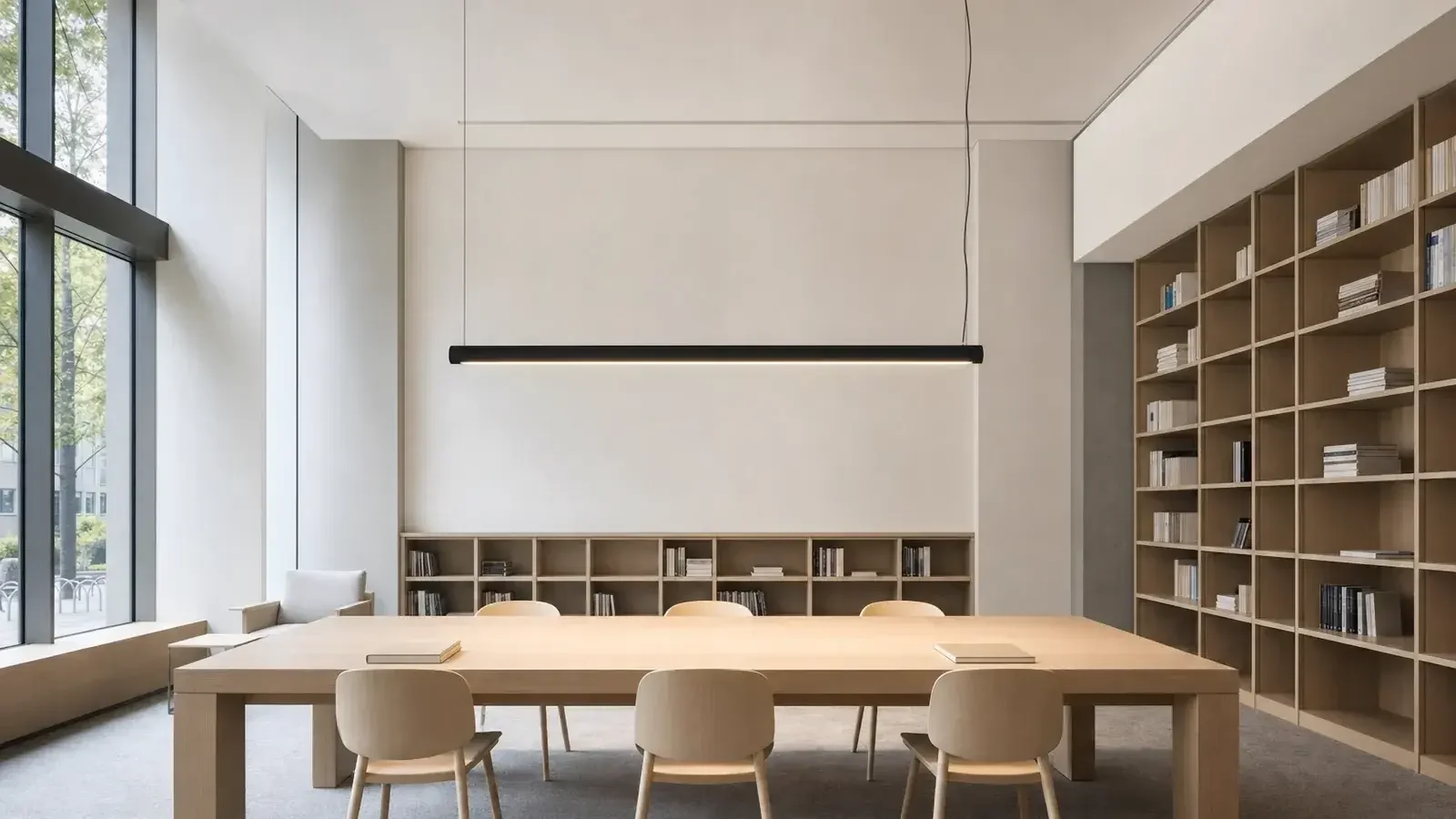
Education spaces work hard. Classrooms switch between screens, whiteboards and group work, libraries need calm, even light, and everything has to be efficient and easy to maintain.
Classrooms
Typical classroom schemes target around 300 lux, rising to 500 lux for adult education and evening classes. Low glare matters because students look up at boards and screens constantly. Direct/indirect linear pendants or recessed linear with microprismatic diffusers give comfortable, even light.
Libraries and study areas
Continuous linear runs along shelving and above study desks create uniform light and a calm, ordered look. Wall-mounted linear can light shelving faces.
Atria and circulation
Suspended linear in geometric layouts turns large volumes into landmark spaces. The radial layout at the National Mathematics and Science College is a good example.
Controls and energy
- Daylight dimming near windows
- Presence and absence detection in classrooms
- Scene setting for presentation modes
- Integrated emergency lighting
See all applications or send us your drawings.
Further reading at 299 Lighting
Next steps on linear-led.com
Specifying a linear scheme?
Send us your drawings or brief. We'll come back with a shortlist, photometrics and LG7 calculations.
Start a project →Frequently asked questions
How much light does a classroom need?
Classrooms are typically designed to around 300 lux, with 500 lux for adult education and evening classes, together with good uniformity and glare control.
What type of lighting is best for classrooms?
Low-glare linear LED lighting, either suspended direct/indirect or recessed with microprismatic diffusers, gives comfortable, even light for classrooms.