In short
How to plan linear LED lighting for wards, clinics and treatment rooms: patient comfort, examination light, glare, cleaning, controls and refurbishment.
Healthcare Estates 2026 took place at Manchester Central on 13 and 14 October. Owned by IHEEM, the event brought together more than 250 exhibitors, with themes including energy and sustainability, smart technology and planning, design and construction (Healthcare Estates).
For estates teams, lighting sits across several of those themes at once. This guide looks at how linear lighting can be planned for wards, clinics and treatment rooms. For corridors, see our separate guide to healthcare corridor lighting.
Wards: two users, one room
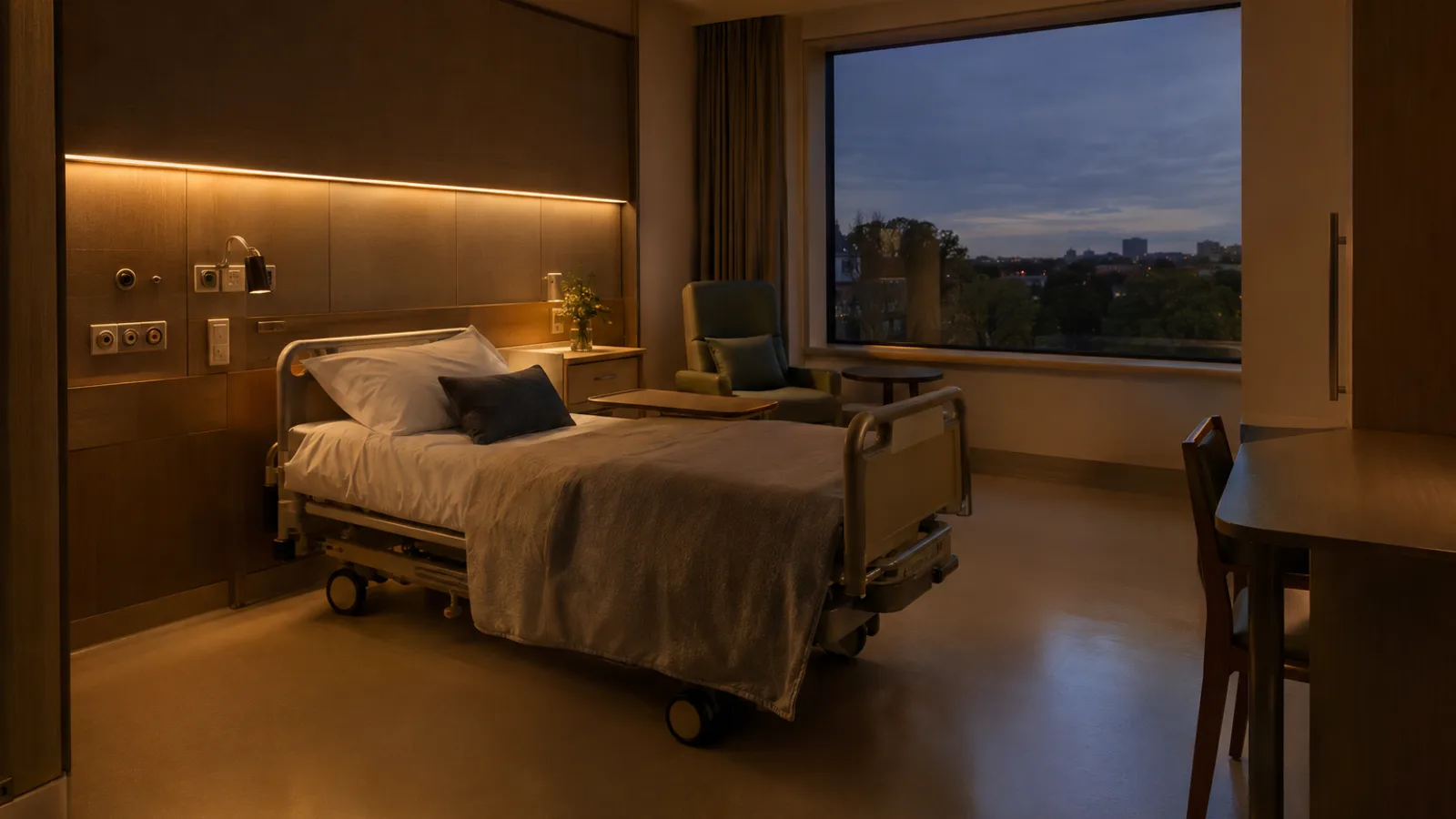
A ward has to work for patients lying down and for staff working on their feet. That usually means:
- Soft, low-glare general light, so patients are not looking into bright sources
- Higher light at the bed head for examination and care tasks, switched or dimmed locally
- Low-level night lighting so staff can move around without waking patients
Indirect or direct/indirect linear fittings light the ceiling and walls, which helps reduce glare for people lying in bed. Our guide to UGR19 and glare explains how glare is rated.
Clinics and treatment rooms
Consultation and treatment rooms need good, even light on the patient and the work surface. Colour rendering matters wherever skin tone is assessed, so ask for high-CRI options. See CRI for architects.
Light through the day
Patients may spend long periods indoors. Tunable white systems can shift colour temperature through the day, cooler in the morning and warmer in the evening. Read tunable white and circadian lighting before committing, as controls and commissioning add cost.
Practical checks
| Topic | What to check |
|---|---|
| Cleaning | Sealed, smooth diffusers that can be wiped down |
| IP rating | Suitable for the cleaning regime in each room |
| Controls | Local bed-head control and a night mode |
| Emergency lighting | Integrated or separate, tested and logged |
| Maintenance | Drivers and LED modules that can be replaced on site |
For emergency fittings, see emergency lighting in linear systems, and for controls, DALI vs Casambi. For downlights in clinical spaces, read recessed lighting for healthcare, and for plaster-in details, trimless lighting in healthcare and education.
Refurbishing existing wards
Many healthcare buildings have existing fluorescent or early LED fittings. Where housings are sound, a lighting retrofit can replace the gear inside without new fittings; see is my luminaire housing worth keeping?. Electrical designers should also check the revised medical locations requirements in the current edition of BS 7671.
299 Lighting supports healthcare projects with layouts, calculations and project support. Send us your drawings to start.
Further reading at 299 Lighting
Next steps on linear-led.com
Specifying a linear scheme?
Send us your drawings or brief. We'll come back with a shortlist, photometrics and LG7 calculations.
Start a project →Frequently asked questions
When was Healthcare Estates 2026?
13 and 14 October 2026 at Manchester Central. The event is owned by IHEEM.
What lighting suits a hospital ward?
Low-glare general light for patients, higher local light at the bed head for care tasks, and a low-level night mode for staff.
Is tunable white lighting useful in hospitals?
It can shift colour temperature through the day for patients who spend long periods indoors, but controls and commissioning add cost.
Can existing ward lighting be retrofitted?
Often, yes. Where housings are sound, the LED gear inside can be replaced instead of fitting new luminaires.