In short
London Museum opens at Smithfield on 28 November. How to plan linear LED lighting for museums, exhibition spaces and heritage halls.
London Museum's new free permanent galleries open on 28 November 2026 in Smithfield's historic General Market. The City of London says "after three decades, Smithfield's historic General Market is being brought back to life with evocative underground galleries and a day-to-night programme that will light up the former trading floor" (City of London). The museum was designed by Stanton Williams and Asif Khan, with conservation architects Julian Harrap, and the adjacent Poultry Market is due to open in 2028 (London Museum).
Neither source describes the lighting, so this guide is not about that museum. It looks at how linear LED lighting can support museums and exhibition spaces in general, from large heritage halls to small temporary galleries.
What museum lighting has to do
Museum lighting balances several needs:
- Show objects well, with accurate colour and good modelling
- Protect sensitive items from too much light
- Help visitors find their way through galleries
- Reveal the building, especially in historic halls
- Adapt as displays change
Linear lighting is one of several tools. It works well for general lighting, wall washing, showcases and wayfinding.
Where linear works
| Use | What it does | Linear approach |
|---|---|---|
| General gallery light | Even background light | Recessed or suspended linear with low glare |
| Wall washing | Even light on walls and hung works | Asymmetric wall-wash linear |
| Showcases | Light inside display cases | Compact linear in the case head or base |
| Circulation | Lead visitors through spaces | Continuous lines. See corridor and wayfinding lighting |
| Heritage halls | Reveal structure | Concealed linear on beams, ledges or cornices |
| Cafés and shops | Comfortable public spaces | See linear lighting for hospitality |
Colour rendering
Accurate colour matters for paintings, textiles and objects. Specify high colour rendering and check the data, not just the headline figure. See CRI and colour rendering for architects.
Colour temperature
Warm white often suits historic objects and heritage interiors, while some displays may suit neutral white. Keep colour temperature consistent within each gallery. Tunable white allows curators to adjust it for each display. See colour temperature and tunable white.
Protecting objects
Light can damage sensitive materials such as paper, textiles and some pigments over time. Conservators set limits on light levels and exposure for sensitive items, so lighting needs to be dimmable and controllable. LED sources emit little ultraviolet or infrared compared with older sources, but levels still need to be managed. Work closely with the museum's conservation team on light levels for each display.
Glare and visual comfort
Visitors move around and look in many directions. Hidden sources and good optics keep glare down, so attention stays on the objects. See UGR 19 explained and microprismatic vs opal diffusers.
Flexibility for changing displays
Temporary exhibitions change several times a year. Linear lighting can support this through:
- Track-mounted linear and spotlights that can be moved
- Plug-and-play connections. See plug-and-play linear systems
- Addressable controls, so levels and scenes can be changed in software. See DALI vs Casambi
Lighting heritage halls
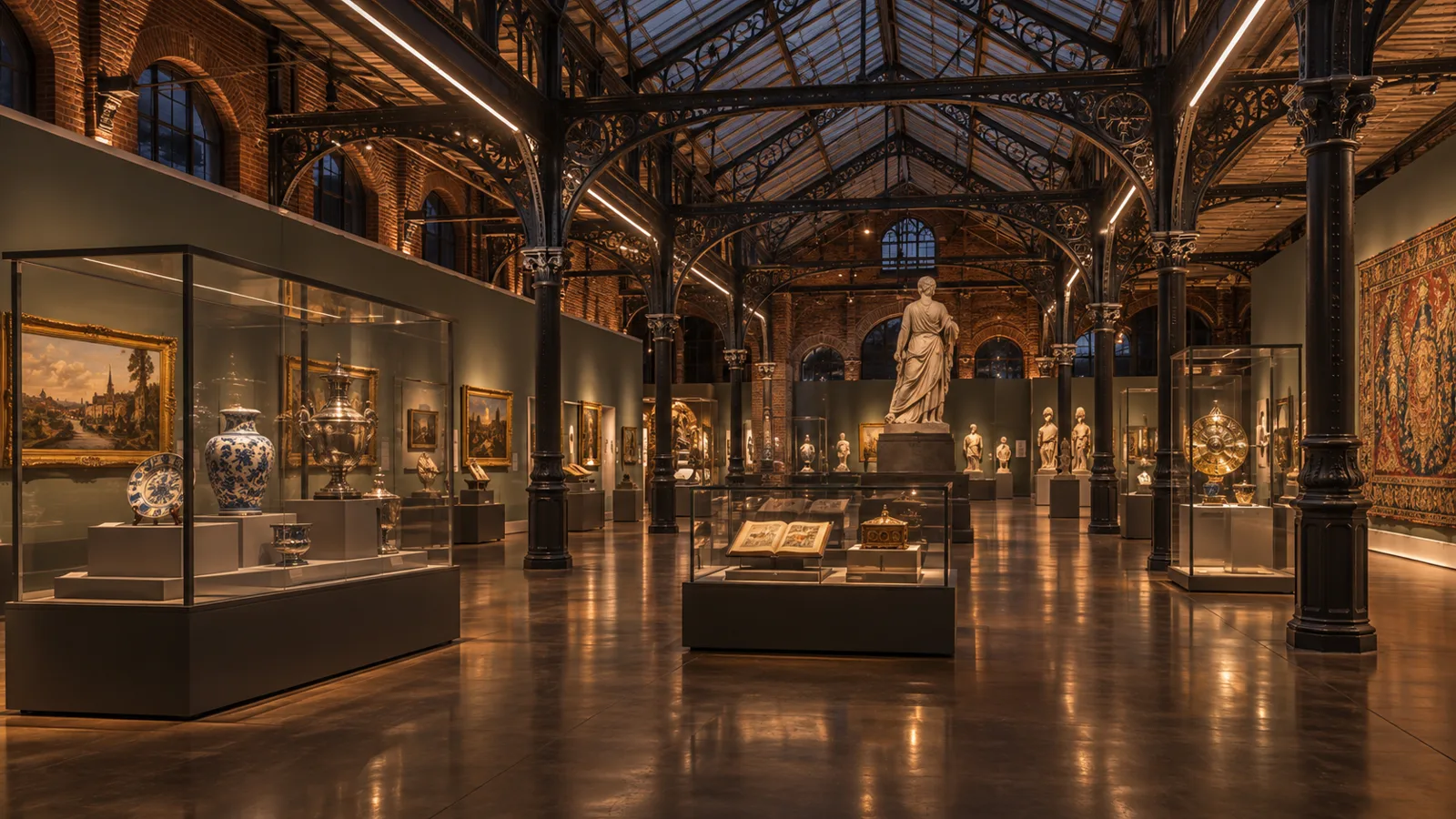
Historic market halls, railway buildings and industrial spaces often have strong structure: iron columns, roof trusses and domes. Linear lighting concealed on beams or ledges can reveal this structure without adding visible fittings. Read our guide to linear lighting in Art Deco buildings for approaches in older buildings, and surface linear for refurbishment where ceilings cannot be opened.
Underground galleries
Below-ground spaces have no daylight, so lighting sets the whole mood. Light walls and ceilings to avoid a closed-in feel, and plan for long operating hours with efficient luminaires. See lumens per metre and efficacy and direct vs indirect linear lighting.
Maintenance and lifetime
Museum ceilings can be high and access may be limited when galleries are open. Choose luminaires with good lumen maintenance and plan access for maintenance. See LED lifetime: L70 and L80.
Emergency lighting
Public buildings need emergency lighting for escape routes and open areas. Integrated emergency modules in linear runs keep ceilings tidy. See emergency lighting in linear systems.
Lighting temporary and touring exhibitions
Touring shows bring their own requirements, often set out in loan agreements by lenders. Galleries that host them need lighting that can meet a different brief each time. A flexible grid of track or plug-and-play linear, with spare capacity in power and controls, lets each show be lit without new installation work. Keep a record of light levels and settings used for each exhibition, so successful scenes can be recalled and lenders' requirements can be demonstrated. Good scene control also lets the space switch from daytime displays to evening events, receptions and late openings, without changing any fittings on site.
Checklist
- Agree light levels with curators and conservators
- Specify high colour rendering and a consistent colour temperature
- Use wall washing for hung works and showcases for sensitive items
- Plan flexible, addressable lighting for temporary exhibitions
- Reveal heritage structure with concealed linear details
- Plan emergency lighting and maintenance access
For plaster-in details in galleries, see trimless lighting for galleries, and for downlights in museum cafés and shops, recessed lighting for retail.
How 299 Lighting can help
299 Lighting supplies linear lighting and bespoke solutions for public and heritage buildings, with layouts, calculations and project support. Send us your drawings to start.
Further reading at 299 Lighting
Next steps on linear-led.com
Specifying a linear scheme?
Send us your drawings or brief. We'll come back with a shortlist, photometrics and LG7 calculations.
Start a project →Frequently asked questions
When does London Museum open at Smithfield?
The new free permanent galleries open on 28 November 2026 in Smithfield's historic General Market.
Why use linear lighting in museums?
Linear fittings suit general lighting, wall washing, showcases and wayfinding, and can be concealed to reveal heritage structure.
What colour rendering do museums need?
High colour rendering helps show objects accurately. Check the data and agree requirements with the museum.
How do you protect sensitive objects from light?
Conservators set light levels and exposure limits for sensitive items, so lighting must be dimmable and controllable.