In short
How to plan linear LED lighting for hybrid offices: zones for focus and collaboration, video calls, occupancy controls and layouts that can change.
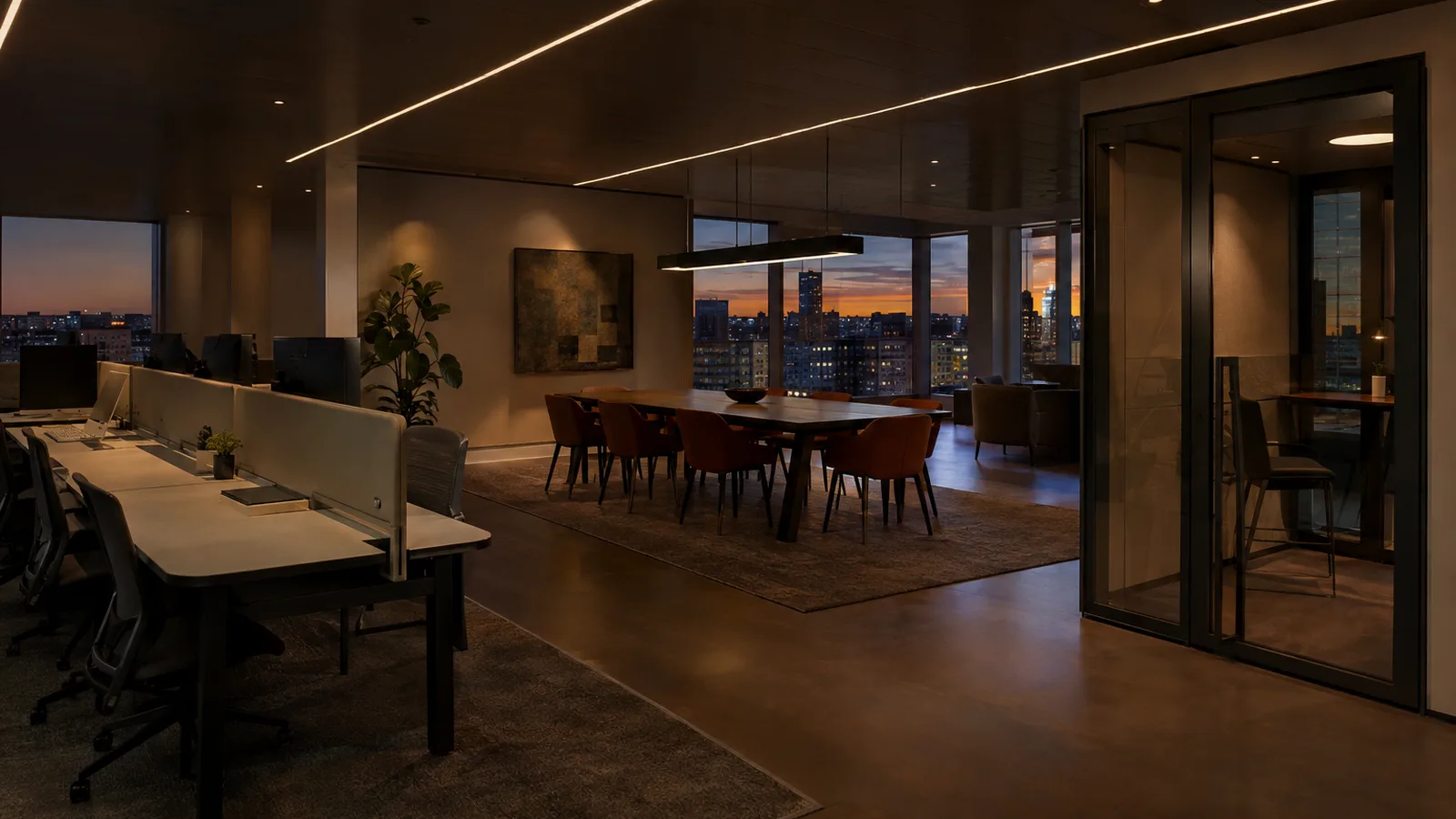
On 28 October 2026, Fagerhult published a piece on rethinking office lighting for a less predictable workplace. "The office has not disappeared, but its pattern of use has changed," it says, noting that in a hybrid office "attendance can peak mid-week, differ between departments and change according to meetings, deadlines and individual working patterns" (Fagerhult).
Its conclusion is that "the implication is not simply that fewer luminaires are required. Lighting must support several distinct uses within the same floorplate." For linear lighting, that changes how layouts, zones and controls are planned. This guide sets out how.
Why hybrid offices need different lighting
A traditional open-plan office was lit as one big, even area, with rows of fittings on a fixed schedule. Fagerhult points out that "lighting large areas according to a fixed schedule may no longer reflect how a space is used". Hybrid floors tend to have:
- Fewer fixed desks and more shared or bookable desks
- More meeting rooms, video-call booths and collaboration areas
- Quieter focus zones alongside busy social spaces
- Days when the floor is full and days when it is nearly empty
- Furniture and partitions that move as teams change
Lighting has to work for all of these, and keep working as the layout changes.
Light each activity
Fagerhult notes that "different activities have different visual and atmospheric requirements". Here is how linear lighting can support each one:
| Zone | What it needs | Linear approach |
|---|---|---|
| Focus desks | Task light and low glare | Recessed or suspended linear with UGR 19 or below |
| Collaboration areas | Good vertical light to see faces | Direct/indirect suspended linear |
| Video-call rooms | Balanced light on faces and backgrounds | Linear with a soft diffuser plus wall lighting |
| Informal and social areas | Softer, warmer light | Lower levels, warmer colour temperature, decorative accents |
| Circulation | Wayfinding | Continuous lines that lead the way |
For the detail on each, read UGR 19 explained, direct vs indirect linear lighting, boardroom and meeting room lighting and corridor and wayfinding lighting.
Use light to define zones
Fagerhult suggests that "lighting can also help define areas without separating every activity with a physical wall". With linear lighting, you can do this through:
- Distribution: direct light over focus desks, direct/indirect over collaboration tables
- Light level: brighter in task areas, softer in breakout zones
- Colour temperature: neutral white for work, warmer white for social areas. See colour temperature and tunable white
- Luminaire type: a change from recessed to suspended linear signals a different use
- Run direction: lines that follow desks in one zone and the circulation route in another
Controls do the heavy lifting
In a hybrid office, controls matter as much as the fittings. Fagerhult says "occupancy detection and more precise controls can allow lighting to respond to where people are actually working, rather than to an assumed level of attendance".
Presence and absence detection
Sensors switch or dim lighting in areas that are empty. On quiet days, that can cut energy use. See daylight dimming and presence detection.
Addressable control
DALI and wireless systems let each luminaire or group be set and reset in software, so zones can change without rewiring. See DALI vs Casambi.
Scenes
Meeting and video-call rooms benefit from simple scenes, such as presentation, video call and cleaning. Keep the buttons clear and the number of scenes small.
Plan for change
Fagerhult notes that "adaptable lighting infrastructure and flexible controls can help a scheme remain aligned with the workplace as furniture, partitions and team locations change". With linear lighting, that means:
- A regular grid or continuous runs that can serve different furniture layouts. See continuous run linear lighting
- Plug-and-play connections, so fittings can be moved or added easily. See plug-and-play linear systems
- Cat A lighting that suits a range of Cat B fit-outs. See Cat A vs Cat B lighting
- Zoning in software, not wiring, so new layouts are a reprogramming job
Energy and certification
Lighting a half-empty floor at full output wastes energy. Efficient luminaires and good controls help with BREEAM, WELL and NABERS UK targets. See lumens per metre and efficacy and BREEAM and WELL lighting. CIBSE's LG7 guide covers office lighting in detail: read CIBSE LG7 explained.
Refurbishing for hybrid working
Many firms are adapting existing offices rather than moving. In a refurbishment, it may be possible to keep existing fittings, upgrade them and add controls. relumen8.com explains adding sensors during a retrofit and office lighting upgrades for landlords. For new linear runs in older buildings, see surface linear lighting for refurbishment.
A quick hybrid office checklist
- Map the zones: focus, collaboration, video, social and circulation
- Set target light levels, glare limits and colour temperature for each zone
- Choose distribution and mounting to suit each zone
- Specify presence detection and addressable controls
- Use layouts and connections that can adapt as furniture moves
- Agree simple scenes for meeting and video rooms
For downlights in meeting rooms and breakout areas, see recessed lighting for offices, and for feature pendants in social spaces, suspended lighting for offices.
How 299 Lighting can help
299 Lighting supplies linear lighting and bespoke solutions for offices, with layouts, calculations and project support. Send us your floor plans to start.
Further reading at 299 Lighting
Next steps on linear-led.com
Specifying a linear scheme?
Send us your drawings or brief. We'll come back with a shortlist, photometrics and LG7 calculations.
Start a project →Frequently asked questions
How is lighting a hybrid office different?
Hybrid floors have more varied activities and changing attendance, so lighting needs zones, occupancy controls and layouts that can adapt.
What lighting suits video-call rooms?
Balanced light on faces and backgrounds, with soft diffusers and some light on walls, so faces are clear without glare.
Do hybrid offices need fewer light fittings?
Not necessarily. Fagerhult notes the space must support several distinct uses within the same floorplate.
Which controls suit a hybrid office?
Presence detection, daylight dimming and addressable DALI or wireless controls that allow zones to be changed in software.